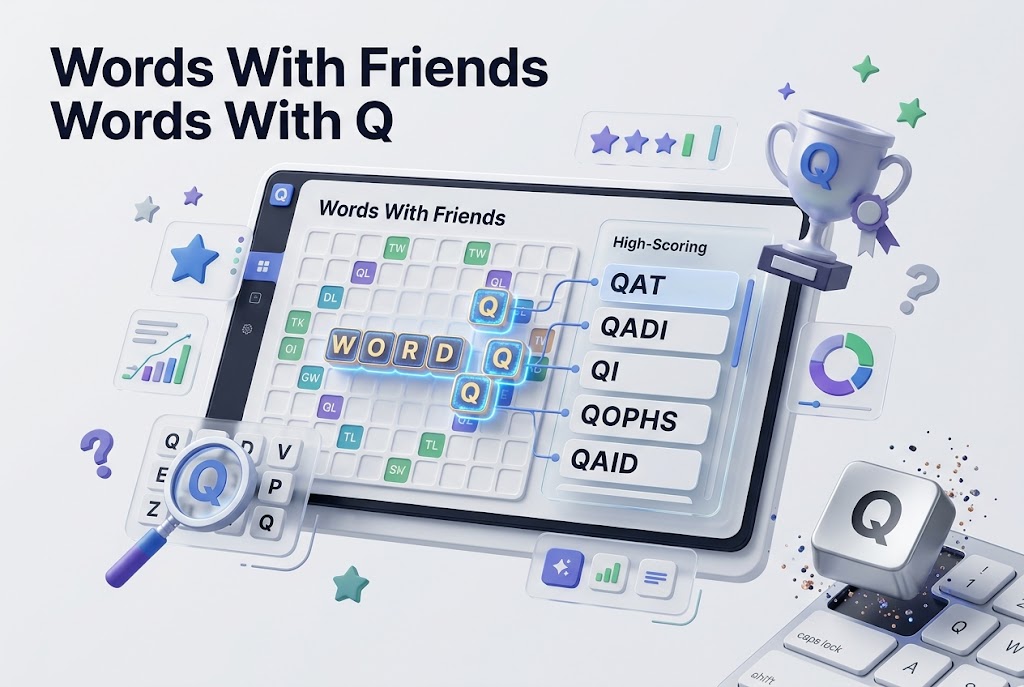
Finding a playable Q word can rescue a difficult rack, especially when the U is missing or the board offers little room. The most useful Words With Friends words with Q include short options such as QI and QAT, along with longer choices such as QADI, QAID, QOPH, and QANAT. These words help you place the 10-point Q tile without waiting several turns for a U.
The best move is not always the longest word. A two-letter play can reach a Triple Letter space, create multiple crosswords, or prevent an opponent from using a valuable opening. Longer Q words become more useful when you have compatible letters, an open lane, or a high-value premium square.
This article covers practical Q words by length, Q-without-U options, scoring tactics, rack management, and common mistakes. You will also learn how to verify unfamiliar entries because accepted words can change when Words With Friends updates its dictionary. Keep the list nearby while playing, but use the strategy sections to turn those words into stronger moves rather than treating them as isolated vocabulary.
Best Short Q Words for Words With Friends
Short Q words matter because the Q is difficult to place and costly to keep. In Words With Friends, the Q tile is worth 10 points. Playing it quickly can produce a solid score while reducing the risk of carrying an inflexible tile into the final turns.
QI is usually the first word players should remember. It uses only two board spaces and does not require a U. QAT is another compact option, while QIS and QATS can help when plural forms fit the board. Always confirm acceptance in the current game before relying on a less familiar variation.
Useful Two-Letter Q Words
QI is the essential two-letter Q word. It refers to vital energy in Chinese philosophy and is commonly pronounced like “chee.” Its unusual spelling makes it particularly valuable in word games because it pairs Q directly with I.
The base tile value of QI is 11 points: 10 for Q and 1 for I. That modest-looking play can score much more when the Q lands on a Double Letter or Triple Letter square, or when both letters contribute to perpendicular words.
Useful Three-Letter Q Words
QAT is a three-letter word for a shrub whose leaves are chewed as a stimulant in parts of East Africa and the Arabian Peninsula. Its letters are easy to find compared with those required by many longer Q words.
Several short extensions may also be available, including the plural forms QIS and QATS. Plurals are tactically valuable because adding one tile to an existing word can create a new scoring opportunity without requiring a large open area.
Quick reference for compact Q plays:
- QI: the most important two-letter Q word
- QIS: the plural of QI
- QAT: a shrub, also spelled KHAT
- QATS: the plural of QAT
- QUA: an informal or specialized term whose acceptance may vary by dictionary version
- SUQ: a marketplace, related to the spelling SOUK
Because game dictionaries can change, treat the current Words With Friends validator as the final authority, particularly for rare three-letter entries.
Words With Q That Do Not Need U
The usual QU pairing can make the Q tile feel unusable when no U appears on your rack. Fortunately, English includes borrowed and transliterated words in which Q is followed by A, I, O, or another letter. Many come from Arabic, Hebrew, Chinese, or other languages.
Learning these entries is more practical than repeatedly exchanging the Q. A compact group of reliable Q-without-U words gives you flexibility without forcing you to memorize dozens of obscure terms that may rarely fit your rack.
Common Q-Without-U Options
QI and QAT are the easiest starting points, but several four- and five-letter words are also useful. QADI and QAID are especially memorable because they use common vowels and consonants. QOPH offers a way to combine Q with otherwise awkward letters such as P and H.
QANAT, TRANQ, and BURQA can solve more specific rack problems. Some forms may depend on the active dictionary, so verify any unusual spelling rather than assuming that acceptance in another word game guarantees acceptance in Words With Friends.
Practical Q-Without-U Examples
Suppose your rack contains Q, A, D, I, R, S, and T. QADI may be available if the board has enough space. If not, QI can dispose of the Q while preserving flexible letters for a later play such as STAR, RAID, or TREAD.
With Q, O, P, H, E, N, and L, QOPH may produce a strong raw score because P and H are valuable tiles too. Yet a strategically placed QI can still win if it reaches a premium square or keeps the board closed.
Key Q-without-U words to learn:
- QI: vital energy
- QAT: a stimulant shrub
- QADI: an Islamic judge
- QAID: a leader or local official
- QOPH: a letter of the Hebrew alphabet
- QANAT: an underground water channel
- BURQA: a type of covering garment
- TRANQ: an informal abbreviation related to tranquilizer
- SUQ: a marketplace
- FIQH: Islamic jurisprudence
Not every spelling appears in every word-game dictionary. Check questionable entries in the game before planning a move around them.
Four-Letter Words With Q
Four-letter Q words provide a useful middle ground. They are easier to place than long words but can score much better than QI, particularly when the supporting letters include D, F, H, or another moderately valuable tile.
Many four-letter options still use QU, including QUAD, QUAY, QUIP, QUIT, and QUIZ. These familiar words are easier to recognize on a crowded board and often accept useful endings, such as S, Y, T, or plural extensions.
Strong Four-Letter Plays
QUIZ is one of the most attractive four-letter choices because Z and Q are both premium tiles. Its base value is high even before board bonuses are counted. The difficulty is assembling both rare letters while also finding I and a playable lane.
QUAY, QUIP, and QUAD are more realistic everyday options. QADI, QAID, and QOPH deserve special attention because they work without U. Keeping several patterns in memory makes it easier to recognize a play immediately instead of overlooking it during a timed turn.
More four-letter possibilities include:
- QUAD
- QUAY
- QUIP
- QUIT
- QUIZ
- QUOD
- QADI
- QAID
- QOPH
- FIQH
Accepted word lists evolve, and regional or informal forms are particularly likely to differ. A current in-game check is safer than relying entirely on a printed list.
Five-Letter and Longer Q Words
Longer Q words can clear a crowded rack and may earn a bonus when all seven tiles are used. They also create more opportunities to cover Double Word and Triple Word spaces. Their drawback is that they require more board room and a more cooperative group of letters.
Useful five-letter choices include QANAT, QUAIL, QUAKE, QUALM, QUEEN, QUERY, QUICK, QUIET, QUILT, QUITE, QUOTA, and QUOTE. Words with common endings or extensions are worth prioritizing because they remain useful across more rack combinations.
Expandable Q Words
An expandable word can be more valuable than a rare high-scoring entry. QUIT can become QUITS, QUITE, or QUITS depending on the available letters and board layout. QUOTE can become QUOTED or QUOTES, while QUEEN may allow QUEENS or QUEENLY.
Extensions also create defensive concerns. Placing an easily expandable word beside a premium square may hand your opponent a simple scoring opportunity. Before committing, examine both ends of the word and consider common prefixes, suffixes, and plural forms.
Long Q words worth recognizing include:
- QANAT
- QUAIL
- QUAKE
- QUALM
- QUARK
- QUART
- QUEEN
- QUERY
- QUEST
- QUICK
- QUIET
- QUILT
- QUITE
- QUOTA
- QUOTE
- SQUARE
- UNIQUE
- ACQUIRE
- EQUATOR
- FREQUENT
- INQUIRE
- REQUIRE
- SEQUIN
For more help building words from difficult racks, see [Internal Link: Words With Friends Letter Combinations].
Q Word Comparison by Length and Use
Word length affects far more than potential points. Two-letter words fit into tight spaces and make parallel plays possible. Four-letter words balance scoring with placement flexibility, while longer words are better suited to open boards and racks containing several compatible vowels.
The following comparison shows how different types of Q words function during a game. Scores shown are base tile totals and can change when premium squares, crosswords, or bonus rules apply.
Word | Length | Uses U | Base tile score | Best tactical use
QI | 2 | No | 11 | Tight spaces and premium Q placement
QAT | 3 | No | 12 | Unloading Q with common support letters
QADI | 4 | No | 14 | Building through A, D, or I
QAID | 4 | No | 14 | Flexible alternative to QADI
QOPH | 4 | No | 18 | High raw score without U
QUAD | 4 | Yes | 15 | Common letters and easy placement
QUAY | 4 | Yes | 16 | Using Y with Q efficiently
QUIP | 4 | Yes | 17 | Strong compact play with P
QUIZ | 4 | Yes | 23 | High tile value before bonuses
QANAT | 5 | No | 14 | Longer U-free option
QUAKE | 5 | Yes | 19 | Strong scoring with K
QUICK | 5 | Yes | 22 | High value with K and C
QUOTE | 5 | Yes | 15 | Useful extension potential
Base scores are helpful for comparison, but board position usually matters more. A low-value QI that creates two crosswords can outscore a longer word placed on ordinary squares.
Scoring More Points With the Q Tile
The Q’s 10-point value makes letter multipliers especially powerful. A Double Letter square adds another 10 points, while a Triple Letter square adds 20 beyond the Q’s normal value. If the completed word also reaches a word multiplier, the final result can rise sharply.
Do not judge the move by the main word alone. A parallel play may produce two or three short crosswords, each scoring the Q again. This is one reason experienced players value compact words: they can create dense, efficient scoring patterns on a developed board.
Prioritize Letter Multipliers
Aim to place Q itself on the premium letter square rather than placing a low-value vowel there. In QI, for example, tripling the Q is far more valuable than tripling the I. Check the orientation carefully before committing the tiles.
Premium squares should not override board safety. A spectacular score may be a poor trade if it opens a Triple Word lane for the opponent. Compare the immediate gain with the likely reply, especially late in a close match.
Create Multiple Words
Parallel placement is one of the strongest techniques in Words With Friends. Instead of extending outward from a single letter, place a short word beside an existing word so that each new tile forms a valid perpendicular word.
QI is ideal for this tactic because it needs only two spaces. If Q and I each connect to existing letters, you score the main word plus both crosswords. The exact setup depends on the board, but the principle applies whenever every adjoining letter combination is valid.
A practical scoring sequence:
1. Identify every legal location for QI, QAT, or another short Q word.
2. Check whether the Q can cover a Double Letter or Triple Letter square.
3. Count all crosswords created by the placement.
4. Compare the total with longer Q-word options.
5. Inspect the opening left for the opponent.
6. Choose the move with the best balance of score, rack quality, and defense.
Managing Q and U on Your Rack
Q and U appear together in many English words, but holding both is not automatically beneficial. They occupy two rack spaces and often need additional vowels. A rack containing Q, U, and several other vowels may lack enough consonants to build a productive move.
When you draw Q without U, search for QI, QAT, QADI, QAID, QOPH, or QANAT before considering an exchange. When you hold U without Q, treat it as a normal vowel rather than saving it indefinitely for a pairing that may never arrive.
When to Exchange the Q
Exchanging can be sensible when no legal Q play exists, the board is closed, and your remaining letters are also poorly balanced. Giving up a turn is costly, so confirm that there is no short placement or useful hook before choosing the exchange option.
The tile bag also matters. Early in the game, exchanging a bad rack can improve future possibilities. Near the end, an exchange may be unavailable or strategically weak because few tiles remain. At that stage, unloading Q usually becomes urgent.
Rack-management checklist:
- Search for QI before assuming the Q is unplayable.
- Look for open I and A tiles already on the board.
- Check Q-without-U words before exchanging.
- Avoid holding U solely because you expect to draw Q.
- Preserve a balanced mix of vowels and consonants.
- Consider the value of the letters remaining after the play.
- Track the tile bag when the game provides that information.
- Dispose of Q before the endgame whenever practical.
Common Mistakes With Q Words
The most common error is waiting too long for U. That approach ignores QI and several useful Q-without-U words. It can leave the Q trapped on the rack while more flexible plays disappear from the board.
A second mistake is choosing the longest available word without comparing totals. A short Q word on a premium square may score more, create better crosswords, and leave a stronger rack. Word length is only one part of move quality.
Relying on Another Game’s Dictionary
Words accepted in Scrabble, crossword apps, or older word lists are not guaranteed to work in the current version of Words With Friends. Different games use different lexicons, and updates can add or remove entries.
Use outside lists to generate possibilities, then verify uncertain words through the game. This is particularly important with transliterations, abbreviations, informal expressions, and variant spellings. Losing time or a turn to an invalid entry is avoidable.
Ignoring the Opponent’s Reply
A Q play can score well while exposing a Double Word or Triple Word lane. Before placing the word, imagine the strongest extension or parallel play the opponent could make using the opening.
This defensive check becomes more important as the board develops. A move worth 30 points may be inferior to a 24-point move if the first option gives the opponent an easy 50-point response.
Common mistakes to avoid:
- Saving Q until a U appears
- Forgetting that QI is playable
- Assuming every online Q list matches the game
- Looking only at the main word’s score
- Placing the vowel on a premium letter square instead of Q
- Opening a high-value lane without checking the likely response
- Keeping Q too late in the game
- Memorizing definitions without learning useful letter patterns
Memorizing Q Words Efficiently
A short, usable vocabulary is better than a long list you cannot recall during play. Begin with QI, QAT, QADI, QAID, QOPH, and QANAT. These establish several Q-without-U patterns and cover multiple word lengths.
Next, group familiar QU words by their following vowel: QUA words such as QUAD and QUAY, QUE words such as QUEEN and QUERY, and QUI words such as QUICK and QUIET. Pattern-based study reduces the effort required to retrieve a word from memory.
Learn Hooks and Extensions
A hook is a letter added to the beginning or end of an existing word to form a new one. Knowing that QI can become QIS and QAT can become QATS makes both base words more useful.
Study common endings for longer Q words as well. QUOTE can take D or S, while QUEST can become QUESTS. These small extensions often fit where an entirely new word will not.
Use Active Recall
Reading a list repeatedly creates familiarity but not reliable recall. Instead, cover the answers and challenge yourself to name a two-letter Q word, three Q-without-U words, and several four-letter Q plays.
You can also sort practice racks manually. Given A, D, I, Q, R, S, and T, identify QI and QADI, then compare what remains. This trains both vocabulary and rack evaluation at the same time.
For broader short-word practice, see [Internal Link: Two Letter Words for Word Games].
Verifying Words in the Current Game
The official in-game dictionary or word-check behavior should settle disputes. Search results and printed references can lag behind updates, use a different regional list, or combine entries from multiple games.
Verification is especially useful before memorizing obscure words. If an entry fails consistently in your version, remove it from your study list. Concentrating on confirmed vocabulary prevents hesitation and makes practice more relevant.
Simple verification routine:
1. Check the word in the current Words With Friends game or official word tool available to you.
2. Confirm the exact spelling, including any plural or inflected form.
3. Note whether the word requires a specific game mode or language setting.
4. Record only confirmed entries in your personal study list.
5. Recheck unusual words after significant app or dictionary updates.
Board Strategy for Short Q Plays
Short Q words become stronger as the board gets crowded. QI can slot into narrow gaps, run parallel to existing words, or use a single anchor letter. That flexibility often matters more than the extra letters in a longer play.
Look for lanes where the Q will touch an existing tile and create another valid word. Even a modest cross can transform an 11-point base play into a strong turn, particularly when the Q receives a letter bonus.
Offensive and Defensive Uses
Offensively, use QI or QAT to reach premium squares that longer words cannot access. A compact play may also preserve S, blank tiles, and common consonants for a larger scoring move later.
Defensively, a short word can block a dangerous lane without opening much new space. This is useful when you lead late in the game. You do not always need the highest immediate score; sometimes restricting the board protects the advantage.
Quick strategic comparison:
Do:
-
- Count crosswords before comparing moves.
- Put Q on the strongest available letter multiplier.
- Keep useful combinations such as ER, ST, and IN when possible.
- Block premium lanes when the score is close.
- Use Q early if the opportunity is efficient.
Do not:
- Force a long Q word onto an exposed lane.
- Keep Q for several turns merely to chase U.
- sacrifice a blank tile for U without checking Q-free alternatives.
- Assume a rare word is valid without verification.
- Ignore the value of tiles left on your rack.
Endgame Considerations for the Q Tile
An unplayed Q can be especially damaging near the end because its value may count against you under the game’s end-scoring rules. It is also harder to place once the board has few open spaces and the tile bag is nearly empty.
Plan ahead when the remaining tile count drops. If Q is still on your rack, prioritize legal short plays even when their immediate score is average. A safe QI may be more valuable than holding out for a premium-square opportunity that never appears.
Tracking Open Letters
Scan for exposed I and A tiles that can support QI or QAT. Also note small gaps beside existing words where a parallel play may fit. These locations can disappear quickly if either player closes the lane.
When you do not hold Q, leaving an easy QI opening may help your opponent. Defensive awareness includes recognizing Q opportunities on both racks, especially when the unseen tile pool suggests that the Q is still available.
Practical endgame priorities:
- Unload Q before the final few turns.
- Preserve I or A when they provide a realistic Q outlet.
- Avoid closing your only legal Q lane.
- Watch for opponent-friendly QI placements.
- Prefer certainty over speculative high scores.
- Recalculate rack penalties when comparing close moves.
Conclusion
The key to handling the Q tile is flexibility. Start by memorizing QI, the compact play that works without U and fits into spaces where most Q words cannot. Add QAT, QADI, QAID, QOPH, and QANAT so a missing U no longer leaves you without options. Familiar QU words such as QUAD, QUIP, QUIZ, QUICK, and QUOTE then broaden the range of racks you can use.
Strong play also requires more than vocabulary. Compare premium squares, count every crossword, protect your rack balance, and inspect the opening your move gives the opponent. Verify rare entries in the current game because dictionary acceptance can vary by version.
The most effective way to study Words With Friends words with Q is to learn a small core list, practice its hooks and extensions, and apply those words to real board patterns. Once QI and the main Q-without-U combinations become automatic, the Q stops feeling like a burden and starts functioning as a reliable scoring tile.
Frequently Asked Questions
What is the shortest Q word in Words With Friends?
QI is the shortest widely accepted Q word, using only two letters and no U. It scores 11 base points before bonuses, making it particularly useful in tight spaces, parallel plays, and premium-letter positions.
Can Q be used without U in Words With Friends?
Yes. Words such as QI, QAT, QADI, QAID, QOPH, and QANAT use Q without U. Acceptance can vary after dictionary updates, so verify unfamiliar entries in the current version of the game.
What is a high-scoring short Q word?
QUIZ is a strong four-letter option because both Q and Z carry high tile values. QOPH is another valuable compact word. Premium squares and crosswords can make a lower-value word such as QI score even more.
Should I exchange the Q tile?
Exchange Q only after checking all legal short plays, especially QI and QAT. An exchange may help an unbalanced early-game rack, but it costs a turn and becomes less useful as the tile bag empties.
Why are some Q words rejected?
Words With Friends uses its own dictionary, which may differ from Scrabble dictionaries, older lists, and regional references. Variant spellings, abbreviations, and rare transliterations are especially likely to differ, so the current game is the final authority.