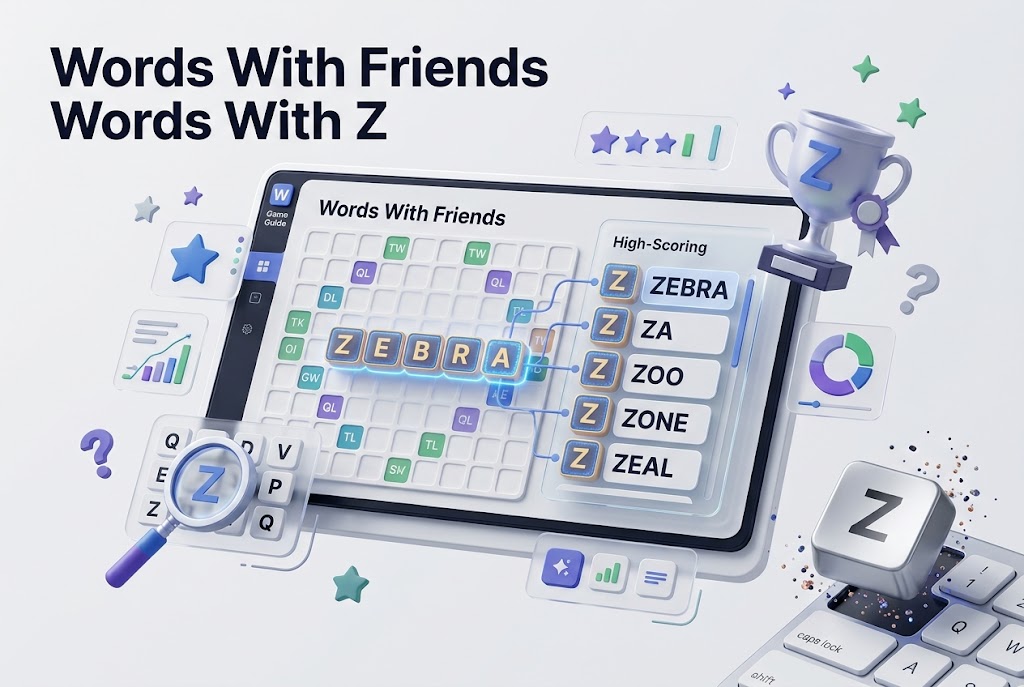
A Z tile can turn a crowded Words With Friends rack into a scoring opportunity, but only when you know where it fits. Players searching for words with friends words with z usually need more than a long alphabetical list. They need playable short words, practical extensions, high-value combinations, and ways to place the letter without sacrificing the rest of the rack.
The Z is worth 10 points in Words With Friends, making it one of the game’s most valuable tiles. Its scoring power comes with a drawback: English uses Z less frequently than most letters, so an unsupported Z can remain on your rack for several turns. The solution is to learn a small group of dependable Z words rather than trying to memorize an entire dictionary.
This article covers useful Z words by length, including the essential two-letter play ZA, short options for tight boards, longer scoring words, and common patterns that make the tile easier to manage. You will also learn how to use premium squares, build parallel plays, check questionable entries, and avoid mistakes that reduce your score.
Words With Friends Z Words at a Glance
The most important fact to remember is that Z carries a base value of 10 points. A simple Z word can therefore outscore a much longer word made entirely from low-value letters. Place the Z on a double-letter or triple-letter square, and its individual value rises to 20 or 30 points before word multipliers are applied.
You do not need an unusually long word to benefit. Short plays such as ZA, ZAP, ZIP, ZIT, and ZOO are often more practical because they fit into restricted spaces. Longer options become useful when the board is open or when an existing letter provides the right starting point.
Useful Z words by length include:
- Two letters: ZA
- Three letters: ADZ, BIZ, FEZ, ZAG, ZAP, ZED, ZEE, ZEN, ZIG, ZIP, ZIT, ZOA, ZOO
- Four letters: BUZZ, COZY, DAZE, DOZE, FAZE, FIZZ, GAZE, HAZE, JAZZ, LAZY, MAZE, RAZE, SIZE, ZEST, ZERO, ZINC, ZING, ZONE, ZOOM
- Five letters: AMAZE, AZURE, BLAZE, BOOZE, CRAZY, FUZZY, GLAZE, GRAZE, HAZEL, JAZZY, MAIZE, PIZZA, PRIZE, ZEBRA, ZESTY, ZILCH
- Six letters and longer: BLAZER, BUZZER, DAZZLE, FIZZLE, GAZING, PUZZLE, SIZZLE, ZIGZAG, AMAZING, FREEZING, ORGANIZE, REALIZE
Acceptance can differ between games and dictionary versions. Treat any unfamiliar entry as a candidate to verify in the current Words With Friends word checker before relying on it during an important match.
The Essential Two-Letter Z Word
ZA is the key two-letter Z word in Words With Friends. It is an informal term for pizza and is valuable because it lets you dispose of the Z with only one supporting tile. With no premium squares involved, ZA scores 11 points: 10 for Z and one for A.
Its real value often comes from board position rather than the base score. ZA can be placed beside an existing word to create several short cross-words at once. It can also connect two parts of a crowded board when longer Z words will not fit.
Why ZA Matters in Tight Games
Late in a match, open lanes tend to disappear. A two-letter word can fit between blocked rows, beside existing tiles, or against the edge of the board. ZA gives the Z much more flexibility at exactly the stage when an awkward tile can become expensive.
Learning ZA also changes how you evaluate an A on your rack. An A may look ordinary, but alongside Z it becomes an immediate scoring pair. Holding the combination briefly can be reasonable when a premium-letter square is accessible and the board is unlikely to close first.
Short Z Words for Crowded Boards
Three-letter Z words provide the best balance between flexibility and scoring. Common, easy-to-remember choices include ZAP, ZIP, ZIT, ZAG, ZIG, ZED, ZEE, ZEN, ZOO, FEZ, and ADZ. Each needs only two supporting letters, so these words are useful when longer lanes are unavailable.
Short words also make strong parallel plays. For example, placing ZIP directly beside an existing word may produce ZIP horizontally while each new tile forms a valid two-letter or three-letter word vertically. The score includes every word created during that turn, which can make a modest-looking placement surprisingly valuable.
Quick placement priorities:
- Look for double-letter and triple-letter squares that can receive the Z.
- Check whether ZA fits against an existing A or Z.
- Test common endings and beginnings around open letters.
- Compare a short parallel play with a longer single-word play.
- Preserve versatile letters such as E, R, S, and T when two placements score similarly.
- Confirm every cross-word before committing to the move.
Useful Three-Letter Words Beginning With Z
Words beginning with Z are easier to spot because the premium tile can be placed first, followed by familiar vowel-consonant combinations. ZAP, ZAG, ZED, ZEE, ZEN, ZIG, ZIP, ZIT, ZOA, and ZOO cover several common rack patterns.
Notice how often A, E, I, and O support the Z. When you draw Z, scan your rack for vowels before considering an exchange. Even one useful vowel may create an immediate play, especially if the board already supplies the third letter.
Useful Three-Letter Words Ending With Z
ADZ, BIZ, and FEZ allow the Z to close a word. These are particularly helpful when a premium square sits at the end of a short lane. A final Z can collect the letter bonus without requiring space beyond the premium square.
Ending with Z may also protect the board. Because relatively few words extend naturally from a final Z, the placement can limit an opponent’s access to the area. That defensive benefit matters when your move approaches a triple-word lane.
Four-Letter Z Words Worth Memorizing
Four-letter Z words appear frequently enough to justify focused study. Strong everyday options include DAZE, DOZE, FAZE, GAZE, HAZE, LAZY, MAZE, RAZE, SIZE, ZEST, ZERO, ZINC, ZING, ZONE, and ZOOM. Their familiar spellings make them easier to recall under time pressure.
Several four-letter words contain two valuable letters or repeated Z tiles. BUZZ, FIZZ, and JAZZ can score heavily even without word multipliers. COZY also combines Z with Y, another useful scoring tile, while requiring only two relatively common supporting letters.
Word-Building Patterns That Simplify Recall
Memorizing patterns is more efficient than treating every Z word as an isolated entry. The -AZE family alone gives you DAZE, FAZE, GAZE, HAZE, MAZE, and RAZE. When you see A, Z, and E on your rack, you only need to search the board or rack for a suitable opening consonant.
The same principle applies to pairs such as ZING and ZINC, or ZONE and ZERO. Grouping words by shared letters makes recall faster. It also helps you identify hooks, which are letters added to an existing word to form a new valid word.
Common pattern families:
- -AZE: DAZE, FAZE, GAZE, HAZE, MAZE, RAZE
- -IZZ: FIZZ, JIZZ
- -UZZ: BUZZ, FUZZ
- ZI-: ZINC, ZING, ZIP, ZIT
- ZE-: ZEBRA, ZED, ZEE, ZEN, ZERO, ZEST, ZESTY
- ZO-: ZOA, ZONE, ZOO, ZOOM
- -IZE: ORGANIZE, REALIZE, UTILIZE
Some members of a pattern may be easier to place than others. Start with familiar words, then add less common entries only after checking that they are accepted by the version of the game you use.
Five-Letter Z Words for Stronger Scores
Five-letter plays are long enough to reach premium squares but short enough to build regularly. Useful choices include AMAZE, AZURE, BLAZE, BOOZE, CRAZY, GLAZE, GRAZE, HAZEL, MAIZE, PRIZE, ZEBRA, ZESTY, and ZILCH. Many use common supporting letters and recognizable spelling patterns.
Words containing two Z tiles are especially productive when both appear on your rack. FUZZY, JAZZY, and PIZZA carry large base values because the word includes 20 points from the Z tiles alone. A premium square under either Z can raise the score sharply.
Examples of base scores before board bonuses:
| Word | Tile calculation | Base score |
| ZA | Z 10 + A 1 | 11 |
| QUIZ | Q 10 + U 2 + I 1 + Z 10 | 23 |
| PIZZA | P 4 + I 1 + Z 10 + Z 10 + A 1 | 26 |
| FUZZY | F 4 + U 2 + Z 10 + Z 10 + Y 3 | 29 |
| JAZZ | J 10 + A 1 + Z 10 + Z 10 | 31 |
These totals do not include double-letter, triple-letter, double-word, or triple-word squares. They also exclude points from cross-words formed during the placement.
Longer Words That Use Z Effectively
Longer Z words become realistic when you can build through letters already on the board. BLAZER, BUZZER, DAZZLE, FIZZLE, GAZING, PUZZLE, SIZZLE, and ZIGZAG are useful six-letter examples. AMAZING, FREEZING, ORGANIZE, and REALIZE can connect with common prefixes or suffixes.
Do not wait for every letter of a long word to appear on your rack. Words With Friends rewards using board tiles as anchors. If GAZE is already present, a suitable letter may produce GAZED or GAZER. If PUZZLE is on the board, an S may create PUZZLES where space permits.
Extending Existing Z Words
Hooks are one of the safest ways to gain extra points. Adding one letter can transform a completed Z word while allowing you to build a second word in another direction. Examples include ZAP to ZAPS, ZOO to ZOOS, ZONE to ZONED or ZONES, and GAZE to GAZED or GAZER.
Plural hooks deserve special attention because S is flexible and easy to overlook. Before using an S elsewhere, scan every Z word on the board for a legal plural. That single tile may score the full value of the existing word again while opening another lane.
Using Prefixes and Suffixes
Common endings expand the number of playable Z words without requiring separate memorization. An S creates many plurals, while -ED, -ER, -ING, and -Y produce forms such as GAZED, BLAZER, GAZING, and FUZZY. Only use a form when it is recognized as a valid standalone entry.
Longer -IZE words can be useful when the board provides several letters. REALIZE, ORGANIZE, and UTILIZE contain familiar components, making them easier to assemble than obscure short words. They also offer multiple connection points for cross-plays.
Seven-Tile Plays Containing Z
Using all seven rack tiles earns the game’s bingo bonus, so a Z should not automatically be treated as a tile to unload immediately. If the rack has a balanced mix of vowels and consonants, it may support a seven-letter word containing Z or connect to an existing board letter.
The practical challenge is rack balance. Z works best when paired with common letters rather than several other inflexible consonants. A rack containing Z plus E, I, A, R, L, and S has more potential than one crowded with Q, V, W, and few vowels.
Checklist for evaluating a possible bingo:
- Count the vowels and consonants on the rack.
- Look for familiar endings such as -IZE, -ING, -ER, and -ED.
- Check whether the board supplies a missing letter.
- Rearrange the rack into likely prefixes and suffixes.
- Confirm that every cross-word created by the placement is valid.
- Compare the bingo score with any shorter premium-square play.
- Consider what lane the move opens for the opponent.
A seven-tile move is attractive, but it is not automatically best. A shorter play placing Z on a triple-letter square and forming multiple cross-words can sometimes score more while exposing less of the board.
Premium Squares and Z Scoring Strategy
A letter multiplier affects only the tile placed directly on it. Put Z on a double-letter square and it contributes 20 points; place it on a triple-letter square and it contributes 30. If the word also reaches a word multiplier, the increased letter value becomes part of the word total before multiplication.
Premium squares apply only when a tile is newly placed. Building through a Z that already occupies a triple-letter square does not reactivate that bonus. You still receive the normal 10-point value of the existing Z when scoring the new word, but not the original multiplier.
Letter Bonuses Versus Word Bonuses
A triple-word square can produce a larger total than a triple-letter square, particularly with a long word. Yet a triple-letter square is unusually effective for Z because it adds 20 bonus points to a single tile. Always calculate both options rather than judging by word length.
The best placements sometimes combine bonuses. A word may position Z on a double-letter square while another newly placed tile reaches a double-word square. Cross-words can also benefit from the Z’s boosted value when the newly placed Z belongs to more than one word.
Parallel Plays With Z
A parallel play places a new word alongside an existing one, creating several perpendicular words. Because the newly placed Z may count in both its main word and a cross-word, its 10-point value can be scored twice during the same turn.
This technique requires careful checking. Every adjacent letter pair or sequence must form an accepted word. Short entries such as ZA are especially important because they make dense parallel placements possible. For more board-control ideas, see [Internal Link: Words With Friends Strategy Tips].
Step-by-step scoring check:
1. Add the values of all letters in the main word.
2. Apply any new letter multipliers to the tiles placed that turn.
3. Apply the main word multiplier after letter bonuses.
4. Calculate every cross-word separately.
5. Apply relevant unused premiums within each cross-word.
6. Add all word totals and any seven-tile bonus.
Balancing Score and Rack Quality
The highest immediate score is not always the strongest move. Playing Z with one or two common letters may leave a balanced rack, while forcing a longer word could leave repeated vowels or difficult consonants. A small difference in points can be worth accepting when the remaining tiles are much stronger.
Think about replacement odds as well. Keeping E, R, S, T, and flexible vowels generally gives you more options next turn. Retaining several duplicate letters or a Q without a U can reduce mobility. Compare both the current score and the likely quality of your next rack.
When to Hold the Z
Holding Z for one turn can make sense when a premium-letter square is likely to remain available, the rack already contains useful support letters, or the board has an obvious opening. This is a calculated delay, not a reason to keep the tile indefinitely.
The risk is that an opponent may occupy the target square or close the lane. Z also carries a large penalty if it remains on your rack when the game ends. As the tile bag empties, prioritize a safe play over waiting for a perfect score.
When to Exchange Tiles
An exchange may be appropriate when Z is trapped among several incompatible consonants and no playable lane exists. You must have enough tiles remaining in the bag for an exchange, and the move scores no points, so it should follow a thorough board scan.
Before exchanging, test ZA and every familiar three-letter option. Look for existing vowels that can support Z at the beginning or end of a word. Exchanging too quickly can discard a tile that would have produced a solid premium-square play.
Do and don’t reminders:
- Do keep Z when you have flexible vowels and a realistic placement.
- Do play Z before the endgame becomes cramped.
- Do compare rack leave when two moves have similar scores.
- Don’t hold Z for several turns based on a premium square that may disappear.
- Don’t exchange before checking two-letter and three-letter plays.
- Don’t empty your rack of useful vowels merely to create a longer word.
Common Mistakes With Z Words
The most common mistake is assuming that every familiar abbreviation, name, or foreign expression is legal. Words With Friends has a broad dictionary, but it does not accept every term seen in conversation. A valid-looking Z combination can still be rejected.
Players also focus too heavily on length. A seven-letter word seems impressive, but ZA on a premium square with profitable cross-words may score more. Evaluate the entire placement, including multipliers, parallel words, rack leave, and the opening created for the next player.
Confusing Similar Spellings
Z words frequently appear in spelling pairs that sound alike or differ by one letter. FAZE and PHASE have different meanings, while RAZE and RAISE are not interchangeable. The word MAIZE uses a Z, but maze does not contain the I. Accurate spelling matters because every tile must match the accepted entry.
American and British spelling can create more uncertainty, especially with words ending in -IZE or -ISE. The game’s dictionary determines which forms are accepted. Check the current in-game word tool rather than relying only on a phone’s spell-checker.
Missing Better Cross-Word Scores
A player may spot ZONE across an open row and stop searching. Yet placing Z in a parallel position could make ZONE plus two or three smaller cross-words, producing a much higher total. Scan both directions before settling on the first valid option.
This habit is especially important when Z can touch an existing A to make ZA. The new Z may belong to the main word and the cross-word, allowing its value to count twice. For related short-word study, use [Internal Link: Two-Letter Words for Words With Friends].
Verifying Words Before You Play
The Words With Friends dictionary can differ from dictionaries used by Scrabble clubs, school assignments, or general spell-checking software. A word accepted in one word game is not guaranteed to work in another. Game updates may also change the recognized lexicon over time.
Use the game’s current word checker or an up-to-date tool specifically labeled for Words With Friends. When studying, keep a personal list of useful verified entries. Focus on short, reusable words rather than filling the list with obscure terms you may never place.
Practical verification routine:
- Confirm the tool is designed for Words With Friends.
- Enter the word without spaces or punctuation.
- Check the exact spelling and letter order.
- Verify inflected forms separately, including plurals and past tense.
- Recheck unusual words after major game or dictionary updates.
- Add dependable results to a short study list.
A checker is most valuable as a learning aid. After verifying a word such as ZA or ADZ several times, commit it to memory so you can recognize the placement quickly during future matches.
Building a Personal Z Word Study List
Start with a compact group you can recall reliably: ZA, ADZ, FEZ, ZAP, ZED, ZEE, ZEN, ZIG, ZIP, ZIT, ZOO, DAZE, GAZE, LAZY, MAZE, SIZE, ZERO, ZINC, ZING, ZONE, and ZOOM. These cover multiple vowels, positions, and board shapes.
Next, add pattern families and high-scoring double-Z words. Review them by arranging physical tiles or using a practice board. Active placement practice is more useful than rereading a long list because it links spelling with the spatial decisions required during a match.
A simple seven-day practice plan:
1. Learn ZA and five three-letter words.
2. Practice words ending in Z, including ADZ and FEZ.
3. Review the -AZE family.
4. Study ZI-, ZE-, and ZO- beginnings.
5. Practice double-Z words such as BUZZ, FIZZ, JAZZ, and PIZZA.
6. Build extensions using S, D, R, and ING.
7. Play a practice game while recording every missed Z opportunity.
The goal is not to memorize every legal word in one session. A dependable set of 20 to 30 entries will solve far more real board situations than a large list you cannot retrieve quickly.
Endgame Tactics for the Z Tile
When few tiles remain, Z changes from an asset into a liability if no lane is available. Unplayed tiles count against you at the end, so a 10-point Z can create a substantial swing. Begin planning its exit before the board becomes completely blocked.
Short words are the safest endgame tools. Protect an A for ZA when practical, note every two-space opening, and avoid closing your only usable lane. If the opponent has very few tiles, favor a guaranteed Z play over waiting for a larger premium-square score.
Important endgame facts:
- Z costs 10 points if it remains unplayed.
- ZA requires only one supporting tile.
- Open vowels on the board may provide a three-letter escape.
- A lower-scoring move can be best if it empties your rack.
- Blocking matters when the opponent may hold a high-value tile.
- Tile tracking helps estimate whether useful letters remain unseen.
Endgame decisions depend on score position. When leading, remove risky tiles and restrict the board. When trailing, a premium-square gamble may be justified, but it should still be based on a realistic lane rather than hope alone.
Conclusion
A strong Z strategy begins with a small set of dependable words, not a massive list of obscure entries. Learn ZA first, then add flexible three-letter plays such as ZAP, ZIP, ZIT, ZED, ZEN, and ZOO. Pattern families such as -AZE, ZI-, ZE-, and ZO- make longer words easier to recognize without relying on raw memorization.
The best words with friends words with z are the ones that fit the board while using premium squares, creating cross-words, and leaving a playable rack. A short placement can outperform a longer word when the Z lands on a letter multiplier or scores in two directions. Calculate the full move instead of judging it by length alone.
Keep dictionary differences in mind and verify unfamiliar entries with a current Words With Friends checker. As the endgame approaches, stop waiting for an ideal opening and prioritize removing the 10-point tile safely. With a reliable short-word vocabulary and disciplined board scanning, Z becomes a scoring tool rather than a tile you dread drawing.
Frequently Asked Questions
Is ZA valid in Words With Friends?
Yes. ZA is accepted in Words With Friends and means pizza. It is the essential two-letter Z play, scoring 11 base points and fitting into narrow spaces where longer words cannot be placed.
How many points is Z worth?
The Z tile is worth 10 points in Words With Friends. Its value becomes 20 on a double-letter square or 30 on a triple-letter square, before any applicable word multiplier is calculated.
What are easy three-letter Z words?
Useful three-letter choices include ZAP, ZED, ZEE, ZEN, ZIG, ZIP, ZIT, ZOA, ZOO, ADZ, BIZ, and FEZ. These compact words are valuable on crowded boards and for building parallel plays.
Should I save the Z for a premium square?
Save it briefly only when a realistic premium-square placement is available. Holding Z too long risks blocked lanes and a 10-point endgame penalty. A reliable moderate score is often better than waiting indefinitely.
Why does a Z word fail in the game?
The word may be misspelled, absent from the current Words With Friends dictionary, or valid only in a different word game. Verify unusual words and their plural or inflected forms with an updated game-specific checker.